“I’m able to find some bugs, but always common, not unique. So I’m a bit stuck.”
I get this kind of DM every week.
Some start with “I can do nothing, help me.”
Others end with “I can do something, but I’m still stuck.”
Some of these people have done security for 1-2 years.
Still no deep bug. Still no private audit.
Today I’m sharing the 3 reasons you’re still stuck in 2026, and what to do instead.
But first, what changed:
AI reads code top to bottom, and it does it well
Contests get thousands of AI-generated reports
A lot of bug bounty teams just don’t pay
The old path was simple.
Join a contest, find a bug, hit the top 10, post it on X, wait for the DMs.
That path is closed.
1. Stop reading code top to bottom. Hunt the 5% that moves money.

Most auditors still read a codebase from top to bottom.
Deposit, then withdraw, then the next file.
They hope a High shows up on the first pass.
Maybe the second.
AI already does that pass.
Some AI workflows do it very well.
So the bugs left for you sit where AI is still weak: the complex, math-heavy parts that need many steps of reasoning.
You don’t need to read everything better than AI. You need to know where to look.
Here’s the order I use:
Understand the codebase: actors, assets, roles, state transitions, assumptions
Do one manual pass, line by line, only to know what sits where
Run an AI workflow for the easy bugs, if you want
Pick the 1 to 5 critical parts: the code that moves funds or runs the core formula
Learn that part deeply, then go backwards from the worst impact
Step 2 is not hunting yet.
And understanding the whole project is not the same as understanding its hardest part.
You need both.
Going backwards means you start at the damage.
“What if this formula is wrong?” “What if someone gets this flow stuck?”
Then you walk left, right and up from that line until you find what can cause it.
While you sit there, you research the bug types this kind of code has.
You chat with AI about it. You write heavy notes.
I did exactly this in a cross-chain messaging contest.
The project had other parts.
I knew they didn’t matter.
One flow was critical. If a message got stuck there, the whole protocol stopped.
So I spent a whole week on about 100 lines of code.
The attack needed many steps: the code, the chain it ran on, and how that chain works.
That kind of multi-step research is where AI still fails.
I found the bug, a denial of service on the messaging.
It paid $10K.
Do this on the codebase you’re on now:
List every function that moves funds or runs a core formula
Pick one
Write its worst impact at the top of a new note
Read backwards from that line for one hour
2. Stop waiting for contests. Hunt live projects.
Contests used to be the fast way in.
One good result, and firms knew your name.
Now your real bug sits in thousands of AI reports.
So don’t wait for the next contest.
Go to projects that are already live. New ones, or ones that ran for a couple of months.
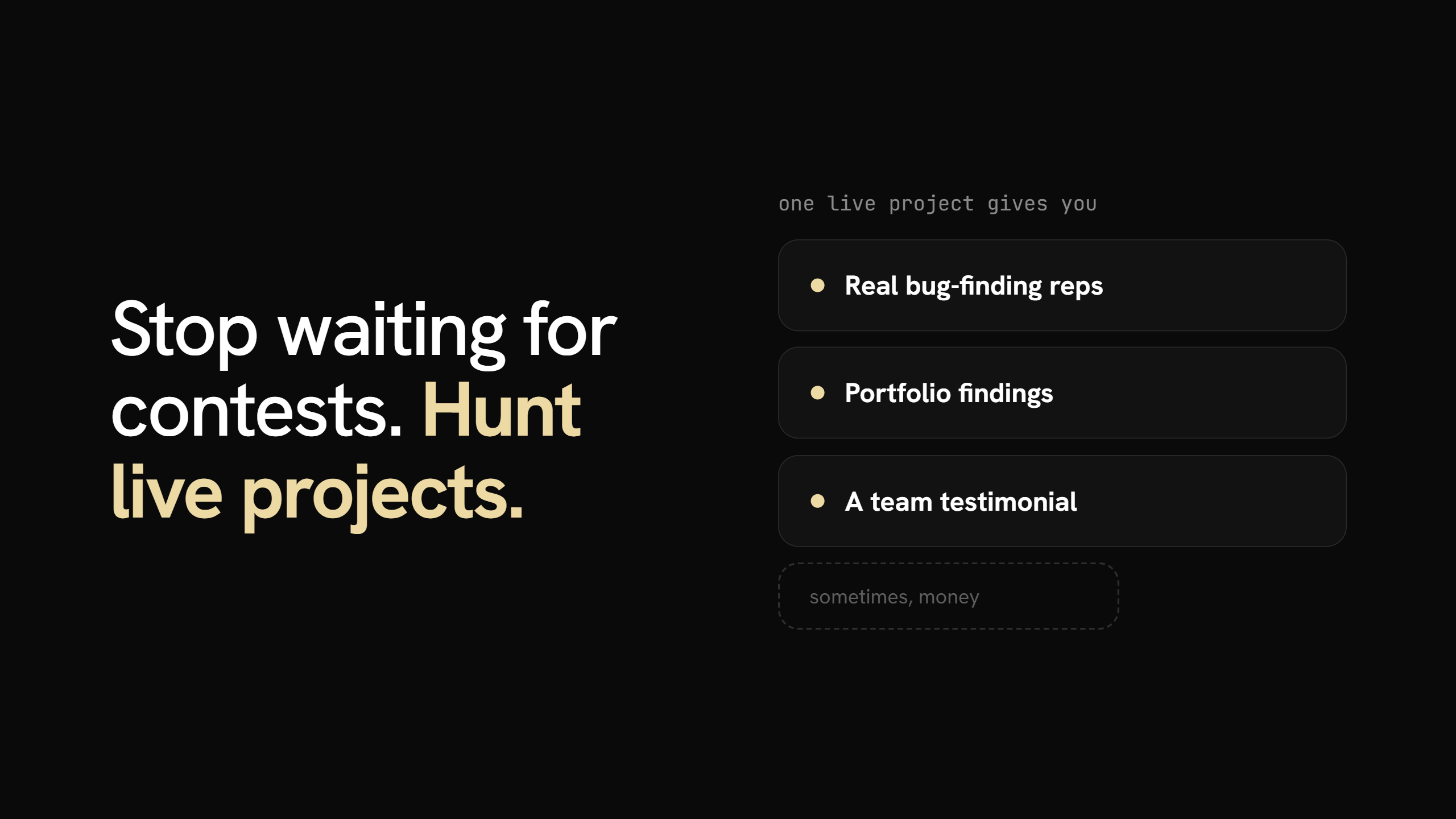
Here’s what one live project gives you:
Real experience finding bugs, with or without AI
Findings for your portfolio
A team that can give you a testimonial
Sometimes, money
The money is the smallest part.
You post the work on X.
You write up the bug, if the team allows it.
Then, when you DM a firm for a private audit, you send the portfolio.
Every week researchers DM me: “Can I work with you? Can I do a private audit?”
Of course you can. But show me what you can do.
Show me your results. Show me your stats.
If there are no stats, what’s the point of working with you?
Prove it to yourself first. Then DM me.
This week:
Pick one project in your domain that has been live for 2+ months
Read its core flow, the 5% from part 1
Test every idea on a local fork, never on mainnet
Report what you find to the team privately, and ask for a testimonial
3. Stop going wide. Take one domain for 90 days.
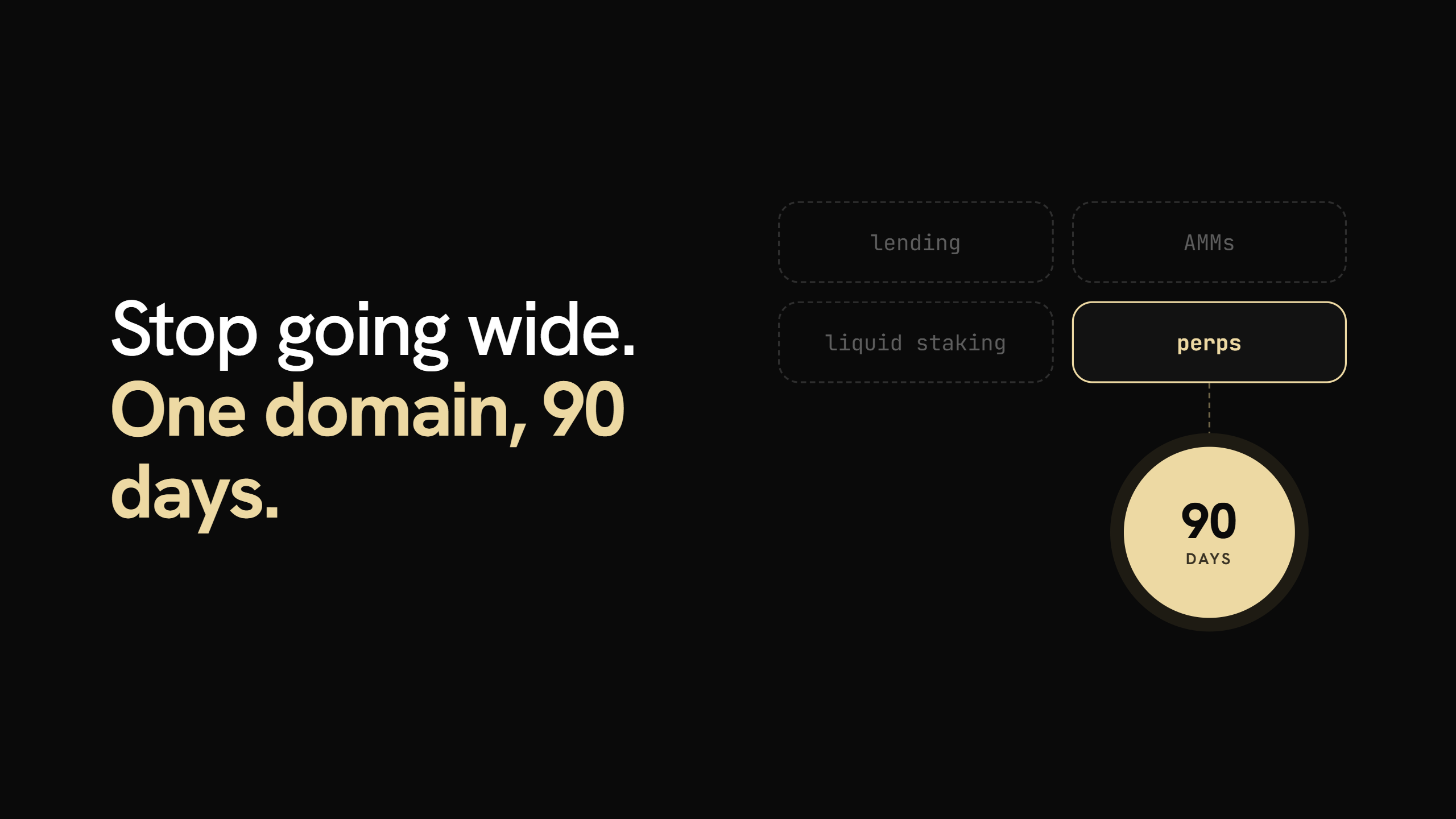
Early in my journey I jumped between domains:
Lending
AMMs
Liquid staking
Cross-chain
Each one has its own bug types, its own knowledge and its own way of thinking.
Switch all the time, and you’re confident in none.
So take one domain and stay there for at least 90 days.
Say perpetual futures.
Open DefiLlama, take the top 3 perps projects, and study them.
Every feature. Every bug type. How each team built it differently.
After that, you can hunt perps on any chain: Solana, Sui, Ethereum.
The design is mostly the same everywhere.
Only the chain-specific bugs change.
Lending works the same way.
On Solana, take Kamino and learn it by heart.
Then audit the projects that integrate with Kamino.
You find bugs there because you know the main project by heart.
Get known for one thing first.
Later, when you do private audits, you can move between domains.
At the start, you can’t.
Today:
Pick one domain
Open DefiLlama and write down its top 3 projects
Block 90 days in your calendar for those 3 only
None of this is fast.
It’s hard work, and the results come late.
But if you do it with a strategy, your chances are much higher than doing it at random.
If you want to find that 5% in a real Solana codebase, with me next to you, start here:
arsen.ac/solana-audits-bootcamp
— Arsen